
Shopify vs WordPress for Ecommerce: What Pakistani Businesses Should Choose in 2026
May 20, 2026
.Blog

Starting an ecommerce business in Pakistan is easier than ever, but choosing the right platform is still one of the biggest decisions online sellers face.
Many business owners start comparing Shopify and WordPress after realizing that the ecommerce platform they choose will affect everything from website speed and SEO performance to payment integrations, scalability, and long-term operating costs.
Both platforms are powerful, but they serve different types of businesses.
Shopify is known for simplicity, fast deployment, and managed infrastructure. WordPress ecommerce, usually powered by WooCommerce, offers deeper customization and ownership flexibility.
For Pakistani businesses, the decision becomes even more important because local payment gateways, courier integrations, scalability requirements, and technical support availability all play a major role in ecommerce success.
This guide compares Shopify vs WordPress for ecommerce businesses in Pakistan to help business owners choose the platform that aligns with their goals, technical skills, and growth plans in 2026.
Understanding Shopify and WordPress Ecommerce
What Is Shopify?
Shopify is a hosted ecommerce platform designed specifically for online selling. It allows businesses to create online stores without worrying about hosting, server management, security patches, or website maintenance.
Everything is managed inside a single ecosystem, including:
- Website hosting
- Product management
- Payment integrations
- Inventory management
- Checkout systems
- Security updates
- Mobile optimization
This makes Shopify popular among startups, small businesses, and growing ecommerce brands that want a simpler setup experience.
What Is WordPress Ecommerce?
WordPress is a content management system that becomes an ecommerce platform through plugins like WooCommerce.
Unlike Shopify, WordPress gives businesses complete ownership and customization control. However, businesses are also responsible for:
- Hosting
- Security
- Website maintenance
- Plugin management
- Performance optimization
- Backups
WordPress ecommerce is often preferred by businesses that need advanced customization or content-heavy SEO strategies.
Shopify vs WordPress: Which Is Easier to Launch?
For most Pakistani businesses entering ecommerce for the first time, Shopify is significantly easier to launch.
A Shopify store can be set up quickly with:
- Built-in themes
- Drag and drop customization
- Integrated checkout
- Preconfigured ecommerce tools
- App-based integrations
There is little technical setup involved.
WordPress ecommerce offers flexibility, but setup is more complex. Businesses typically need:
- Domain configuration
- Hosting setup
- WordPress installation
- WooCommerce setup
- Security plugins
- Performance optimization
- Payment gateway configuration
For non-technical business owners, Shopify usually creates a smoother experience.
Shopify Pakistan: Is Shopify Available in Pakistan?
Yes, Shopify is available in Pakistan, and many businesses use it successfully for ecommerce operations.
However, Pakistani businesses should understand that some features available in other countries may have limitations locally.
For example:
- Shopify Payments is not fully supported in Pakistan
- Businesses often rely on third-party payment gateways
- COD remains important for local ecommerce
- Local courier integrations may require additional apps
Despite these limitations, Shopify still works effectively for many Pakistani ecommerce brands through integrations with:
- Easypaisa
- JazzCash
- Bank transfer systems
- International payment providers
Businesses selling internationally often prefer Shopify because of its strong global ecommerce infrastructure.
WordPress Ecommerce for Pakistani Businesses
WordPress ecommerce remains highly popular in Pakistan because of its affordability and customization freedom.
Businesses can:
- Choose local hosting providers
- Customize checkout experiences
- Integrate Pakistani payment gateways
- Build SEO focused websites
- Reduce recurring subscription costs
This makes WordPress attractive for:
- Small ecommerce businesses
- Content-driven brands
- Businesses with in-house developers
- Companies needing custom workflows
However, the flexibility also comes with operational responsibility.
Without proper optimization, WordPress ecommerce websites can experience:
- Slow loading speeds
- Plugin conflicts
- Security vulnerabilities
- Hosting issues
- Maintenance challenges
Shopify vs WordPress: Pricing Comparison
Shopify Costs
Shopify works on a subscription model.
Typical expenses include:
- Monthly subscription fees
- Premium themes
- Paid apps
- Transaction fees
- Advanced ecommerce tools
The benefit is predictable infrastructure and reduced technical management.
WordPress Ecommerce Costs
WordPress itself is free, but ecommerce businesses still pay for:
- Hosting
- Premium plugins
- Security tools
- Developer support
- Performance optimization
- Maintenance services
At first, WordPress ecommerce may appear cheaper. However, scaling a WooCommerce store can increase operational and development costs over time.
Businesses should compare total ownership costs instead of only comparing subscription fees.
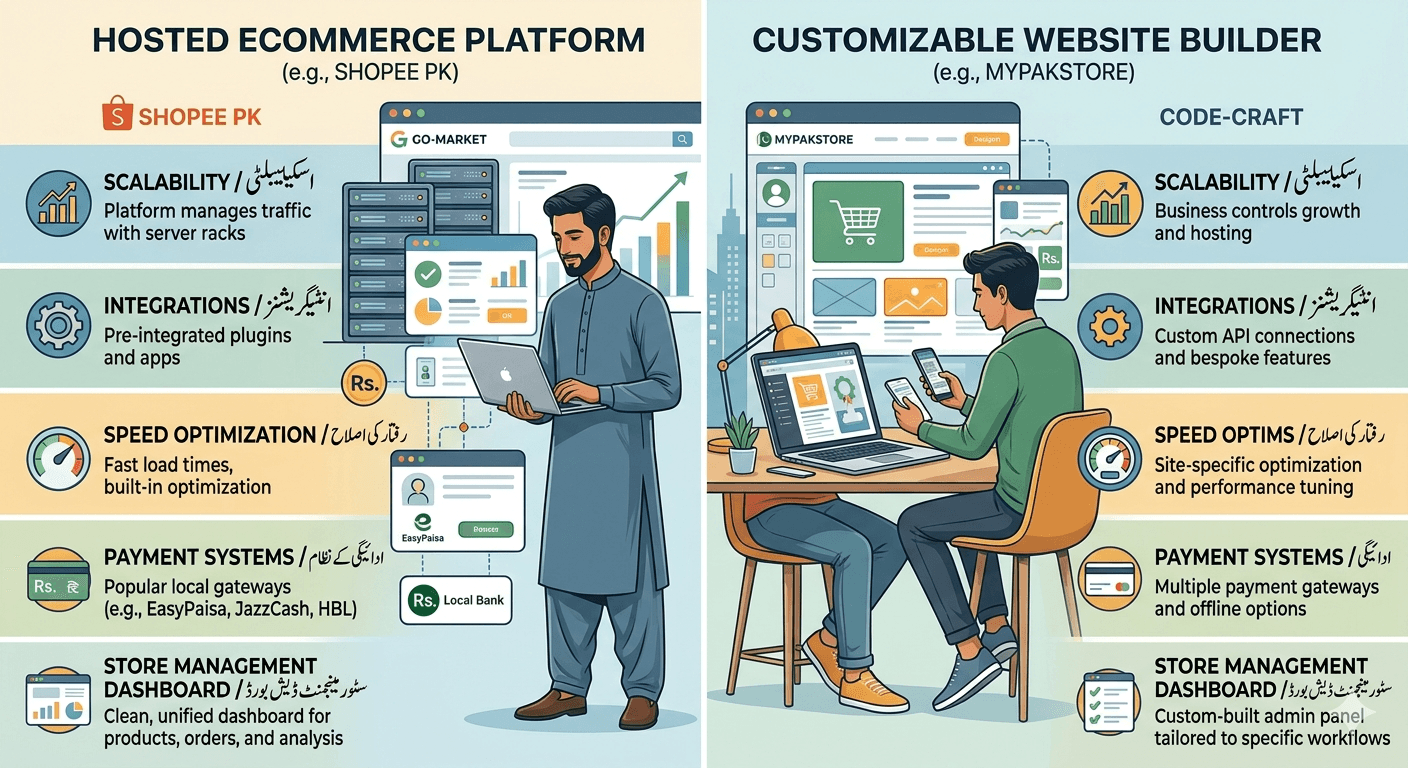
Scalability Comparison
Scalability is one of the most important factors for growing ecommerce businesses.
Shopify Scalability
Shopify is designed for scaling online stores without requiring businesses to manage infrastructure.
It handles:
- Traffic spikes
- Server optimization
- Checkout stability
- Website uptime
- Security scaling
This makes Shopify attractive for businesses expecting rapid ecommerce growth.
Brands managing:
- Large product catalogs
- High order volumes
- Seasonal traffic spikes
- Multi-channel selling
often benefit from Shopify’s managed ecosystem.
WordPress Scalability
WordPress ecommerce can scale effectively, but scalability depends heavily on:
- Hosting quality
- Developer expertise
- Performance optimization
- Plugin efficiency
Large WooCommerce stores often require advanced server management and technical maintenance.
For businesses with strong development resources, WordPress offers nearly unlimited flexibility. For smaller teams, scalability can become operationally demanding.
Website Speed and Performance
Website speed directly affects:
- SEO rankings
- User experience
- Conversion rates
- Cart abandonment
Shopify Performance
Shopify provides optimized hosting infrastructure by default.
Benefits include:
- Fast loading speeds
- CDN support
- Mobile optimized themes
- Stable checkout performance
This reduces the need for technical performance management.
WordPress Performance
WordPress performance depends on setup quality.
A properly optimized WooCommerce store can perform extremely well, but poor hosting or excessive plugins can slow websites significantly.
Performance optimization may involve:
- Caching tools
- CDN integration
- Image optimization
- Database cleanup
- Hosting upgrades
Businesses that prioritize low maintenance often prefer Shopify for this reason.
Shopify vs WordPress for SEO
SEO is critical for ecommerce growth in Pakistan, especially as competition increases across fashion, electronics, beauty, and lifestyle categories.
WordPress SEO Advantages
WordPress is widely known for its strong SEO flexibility.
Businesses can fully customize:
- URLs
- Meta tags
- Blog structures
- Internal linking
- Schema markup
- Content architecture
This makes WordPress excellent for content marketing strategies and long form SEO campaigns.
Shopify SEO Advantages
Shopify also offers strong ecommerce SEO features, including:
- Mobile optimization
- Fast loading pages
- Secure infrastructure
- Clean product pages
However, WordPress still provides deeper content customization for advanced SEO campaigns.
Businesses heavily focused on blogging and organic content marketing may prefer WordPress ecommerce.
Integrations and Ecommerce Tools
Modern ecommerce businesses rely heavily on integrations.
Shopify Integrations
Shopify offers a massive app ecosystem for:
- Inventory management
- Marketing automation
- POS systems
- CRM tools
- Shipping management
- Email marketing
- Social commerce
Many integrations work with minimal setup.
WordPress Ecommerce Integrations
WordPress offers flexibility through plugins and custom development.
Businesses can integrate:
- ERP systems
- Pakistani payment gateways
- Inventory tools
- Custom checkout systems
- Local courier services
This flexibility is powerful, but maintenance becomes more complex over time.
Which Platform Is Better for Pakistani Ecommerce Businesses?
The answer depends on the business model, growth stage, and operational capabilities.
Shopify Is Better For:
- Startups wanting quick deployment
- Non technical business owners
- Fast-growing e-commerce brands
- Businesses focused on operational simplicity
- International ecommerce selling
- Businesses needing reliable infrastructure
WordPress Ecommerce Is Better For:
- Businesses needing full customization
- SEO heavy brands
- Companies with developers
- Budget-conscious startups
- Businesses wanting complete ownership control
- Content-driven e-commerce websites
When Businesses Should Avoid Shopify
Shopify may not be ideal if a business:
- Needs highly customized backend systems
- Wants complete platform ownership
- Requires advanced development freedom
- Wants to minimize recurring subscription fees
When Businesses Should Avoid WordPress Ecommerce
WordPress ecommerce may not be ideal if a business:
- Lacks technical resources
- Wants minimal maintenance
- Needs rapid deployment
- Wants predictable infrastructure management
- Prefers all-in-one e-commerce systems
The Real Ecommerce Challenge Is Operations
Many businesses focus only on website creation while ignoring ecommerce operations.
Even the best ecommerce platform can struggle without proper:
- Inventory management
- POS synchronization
- Order tracking
- Sales reporting
- Customer management
- Stock visibility
This is where ecommerce operations software becomes important.
How Oscar Helps Ecommerce Businesses Scale Smarter
Oscar POS helps ecommerce businesses manage operations beyond just website creation.
Whether a business uses Shopify or WordPress ecommerce, operational efficiency still determines profitability and scalability.
Oscar helps businesses streamline:
- Inventory management
- Retail POS operations
- Sales tracking
- Stock synchronization
- Customer management
- Multi-store operations
- Reporting and analytics
For Pakistani businesses managing both physical and online sales channels, centralized operations can significantly reduce inventory errors and operational inefficiencies.
As ecommerce businesses scale, managing products, stock movement, and customer transactions across platforms becomes increasingly difficult without the right backend systems.
Oscar helps simplify that complexity.
Final Verdict: Shopify or WordPress for Ecommerce in 2026?
There is no universal winner between Shopify and WordPress ecommerce.
The right platform depends on the business itself.
Shopify is generally the better option for businesses prioritizing:
- Ease of use
- Speed
- Reliability
- Scalability
- Lower technical maintenance
WordPress ecommerce is often better for businesses prioritizing:
- Customization
- Content marketing
- SEO flexibility
- Ownership control
- Advanced development freedom
For many Pakistani businesses entering ecommerce in 2026, Shopify offers the fastest and simplest way to launch and scale online stores.
For businesses with stronger technical resources and advanced customization requirements, WordPress ecommerce remains a powerful long-term solution.
The key is choosing a platform that supports both immediate goals and future growth plans.
And once the ecommerce store starts growing, operational systems become just as important as the website itself.
Businesses looking to simplify inventory, sales tracking, and ecommerce operations can explore how Oscar helps retailers and ecommerce brands manage growth more efficiently.
Trying a live Oscar POS demo is often the easiest way to see how ecommerce operations can become faster, smarter, and easier to scale.
FAQs
1. Is Shopify available in Pakistan?
Yes, Shopify is available in Pakistan and many ecommerce businesses use it successfully. However, businesses may need third party payment gateway integrations because Shopify Payments is not fully supported locally.
2. Is WordPress better than Shopify for ecommerce?
It depends on the business requirements. Shopify is easier to manage and scale, while WordPress ecommerce offers greater customization and SEO flexibility.
3. Which ecommerce platform is cheaper?
WordPress ecommerce may have lower starting costs, but maintenance and development expenses can increase over time. Shopify has recurring subscription costs but reduces technical management responsibilities.
4. Which platform is better for SEO?
WordPress generally provides more advanced SEO customization. However, Shopify also offers strong ecommerce SEO performance with fast loading speeds and mobile optimized infrastructure.
5. Can Pakistani businesses use Easypaisa and JazzCash with Shopify?
Yes, Pakistani businesses can integrate local payment methods with Shopify using supported third-party integrations and payment gateway providers.
6. Which platform is easier for beginners?
Shopify is usually easier for beginners because it manages hosting, security, updates, and infrastructure.
7. Is WooCommerce good for large ecommerce stores?
WooCommerce can scale effectively for large ecommerce businesses, but performance depends heavily on hosting quality, optimization, and technical management.
8. How does Oscar help ecommerce businesses?
Oscar helps ecommerce businesses streamline inventory management, POS operations, sales tracking, reporting, and multi store management to improve operational efficiency as businesses grow.