
Why Most E-Commerce Businesses Fail in Pakistan
May 15, 2026
.Blog

Pakistan’s e-commerce industry has grown rapidly over the past few years. From Instagram stores and Shopify websites to Daraz sellers and independent online brands, more entrepreneurs are entering the digital commerce space than ever before. On the surface, e-commerce looks simple. Launch a store, run ads, get orders, and scale.
But the reality is very different.
Many e-commerce businesses in Pakistan struggle to survive beyond their early growth stage. Some fail within months. Others generate sales but remain stuck in operational chaos, low profits, delayed orders, customer complaints, and inventory confusion.
The problem usually is not the product alone.
In many cases, e-commerce businesses fail because their operations cannot keep up with growth.
As order volumes increase, manual processes begin to break. Teams lose visibility, fulfillment slows down, inventory mismatches become common, and customer trust starts declining. Without proper systems and e-commerce operations software, scaling becomes difficult.
This is why many online businesses in Pakistan experience growth initially but fail to sustain it long term.
The Rapid Rise of E-commerce Business in Pakistan
The e-commerce business landscape in Pakistan has changed dramatically. Social commerce, online marketplaces, affordable internet access, and digital marketing have lowered the barrier to entry for entrepreneurs.
Today, businesses can sell through:
- Shopify stores
- WooCommerce websites
- Instagram shops
- Facebook pages
- Daraz
- WhatsApp orders
- TikTok Shop
This accessibility has encouraged thousands of people to start an e-commerce business in Pakistan.
However, starting an online store is not the difficult part anymore.
Running operations efficiently is where most businesses struggle.
Why E-commerce Businesses Fail in Pakistan
1. Lack of Operational Structure
One of the biggest reasons ecommerce businesses fail is poor operational management.
Many stores begin with spreadsheets, WhatsApp messages, manual stock tracking, and scattered order handling. This may work for a small number of daily orders, but as order volume increases, the business starts facing operational bottlenecks.
Common issues include:
- Missing customer orders
- Delayed dispatches
- Duplicate entries
- Incorrect inventory counts
- Team communication gaps
- Slow fulfillment
Operational chaos usually starts quietly and worsens as the business grows.
Without centralized e-commerce operations software, businesses lose control over their workflows.
2. Scaling Too Fast Without Systems
Many e-commerce businesses focus heavily on marketing and paid ads before building a scalable operational foundation.
At first, increasing sales feels like success. But rapid growth can expose weaknesses in backend operations.
A store handling 15 orders a day manually may struggle badly at 200 orders a day.
This often leads to:
- Fulfillment delays
- Customer frustration
- Inventory stockouts
- Higher return rates
- Negative reviews
- Increased operational costs
Scaling an e-commerce business requires more than increasing sales. It requires operational visibility, process automation, and better order management.
3. Inventory Mismanagement Creates Major Problems
Inventory management is one of the most overlooked areas in the e-commerce business in Pakistan.
Many businesses continue managing stock manually across multiple channels, such as:
- Website
- Daraz
- Physical outlets
When inventory is not synced properly, overselling becomes common.
This creates problems such as:
- Cancelled orders
- Refund requests
- Customer dissatisfaction
- Delivery delays
- Dead stock accumulation
Real-time inventory tracking is critical for e-commerce growth. Businesses that cannot manage inventory accurately often struggle to maintain customer trust.
4. Heavy Dependence on Cash on Delivery
Cash on delivery remains the preferred payment method in Pakistan’s e-commerce market.
While COD helps increase conversions, it also creates operational risks.
Businesses often face:
- Fake orders
- Refused deliveries
- High return rates
- Cash flow delays
- Courier complications
Many e-commerce businesses underestimate the financial damage caused by failed deliveries and return losses.
Without proper order verification systems and operational tracking, COD dependency becomes difficult to manage at scale.
5. Marketplace Dependency Limits Long-Term Growth
Many sellers rely entirely on marketplaces like Daraz to generate sales.
While marketplaces provide visibility, over-dependence creates long-term risks:
- High competition
- Reduced brand control
- Pricing pressure
- Limited customer ownership
- Dependency on platform policies
Successful ecommerce businesses eventually focus on building their own operational systems, customer base, and brand identity instead of relying completely on marketplaces.
6. Poor Customer Experience Hurts Retention
Customer expectations in e-commerce continue to rise.
Delayed deliveries, slow support responses, incorrect orders, and poor communication can quickly damage a brand’s reputation.
Common customer complaints in Pakistan include:
- Orders arriving late
- Products being out of stock after purchase
- No order updates
- Slow customer support
- Refund delays
Many e-commerce businesses spend heavily on customer acquisition but fail to retain buyers because operations are inconsistent.
Customer trust is one of the most important factors in e-commerce success.
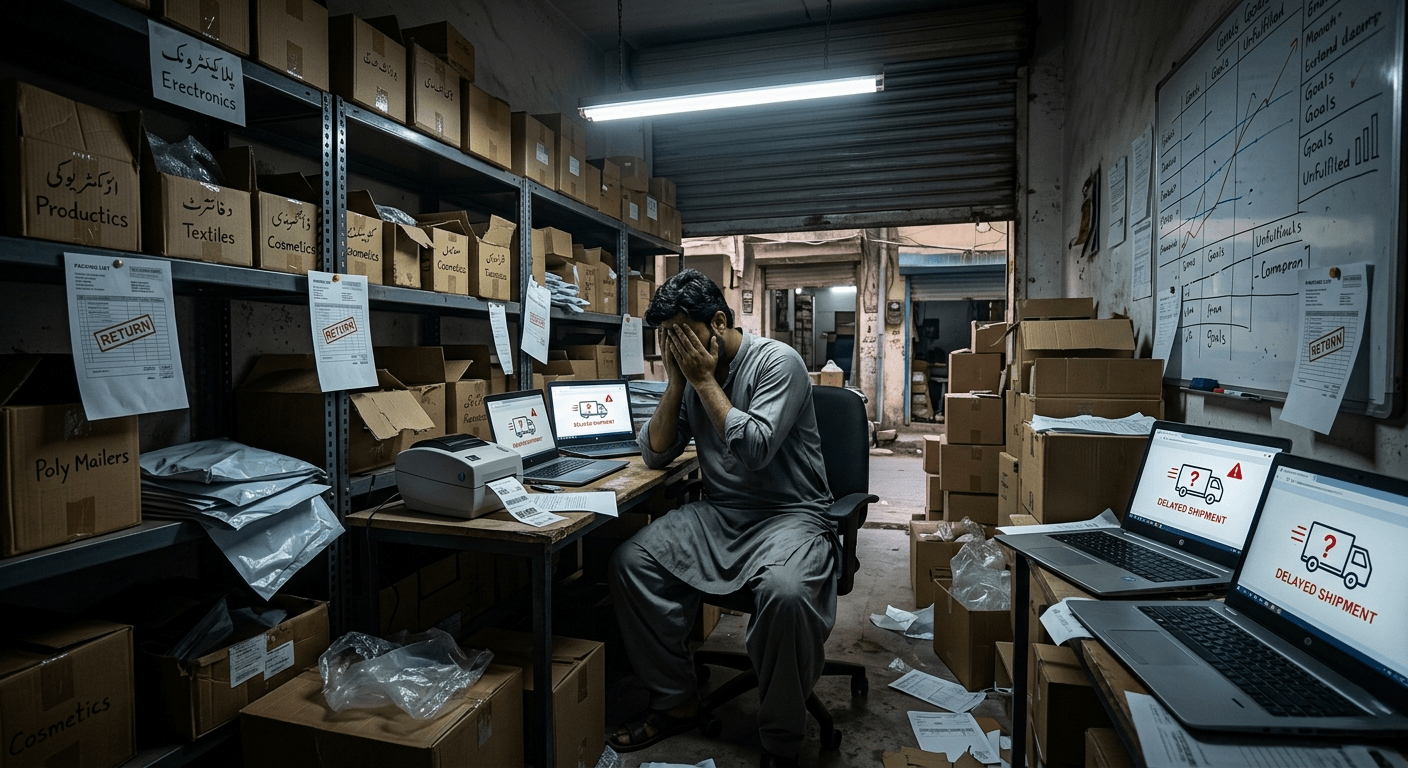
Manual Processes Lead to Operational Chaos
As e-commerce businesses grow, manual workflows become harder to manage.
Many businesses still rely on:
- Excel sheets
- WhatsApp coordination
- Manual invoice creation
- Separate systems for orders and inventory
- Non-centralized reporting
This fragmented workflow creates inefficiencies across the business.
Teams lose visibility. Errors increase. Decision-making slows down.
This is where e-commerce operations software becomes important.
Businesses that automate workflows can improve:
- Order processing
- Inventory synchronization
- Fulfillment efficiency
- Team coordination
- Reporting visibility
The Hidden Cost of Failed Scaling
Failed scaling does not happen overnight.
It usually starts with small operational inefficiencies that compound over time.
A business may continue generating sales while silently losing profitability through:
- Operational delays
- Return losses
- Inventory inaccuracies
- Human errors
- Team inefficiencies
- Poor reporting
Eventually, growth becomes difficult to sustain.
This is why operational infrastructure matters just as much as marketing.
What Successful Ecommerce Businesses Do Differently
Successful e-commerce brands in Pakistan focus on building systems early.
Instead of relying completely on manual processes, they invest in:
- Centralized order management
- Inventory tracking systems
- Automated workflows
- Operational visibility
- Reporting and analytics
- Team coordination tools
They understand that e-commerce success depends not only on selling products but also on managing operations efficiently.
This is where modern e-commerce software for Pakistani businesses can become valuable.
How Oscar Helps E-commerce Businesses Operate Better
As e-commerce businesses scale, managing orders, inventory, payments, and fulfillment manually becomes increasingly difficult.
This is where solutions likeOscar POS help businesses streamline operations and reduce inefficiencies.
Oscar helps ecommerce businesses by centralizing critical workflows in one system, making it easier to manage:
- Inventory across channels
- Order tracking
- Sales visibility
- Operational reporting
- Stock management
- Business workflows
Instead of juggling multiple disconnected tools, businesses can improve operational control through a single platform.
For growing e-commerce brands in Pakistan, this kind of operational visibility becomes essential for sustainable scaling.
Signs an E-commerce Business Is Heading Toward Failure
Many businesses notice problems only after operations become difficult to manage.
Some early warning signs include:
- Inventory numbers never match
- Frequent delivery delays
- Increasing customer complaints
- Teams relying entirely on WhatsApp coordination
- High return rates
- No centralized reporting
- Difficulty tracking profits
- Confusion during high sales periods
Identifying these issues early can help businesses fix operational gaps before growth becomes unmanageable.
The Future of E-commerce Business in Pakistan
Pakistan’s e-commerce industry still has enormous growth potential.
However, competition is increasing rapidly.
Businesses that continue relying on manual systems may struggle to scale efficiently in the future. On the other hand, businesses investing in better operational infrastructure, automation, and customer experience will be better positioned for long-term growth.
E-commerce success today depends on more than just attracting orders.
It depends on how efficiently a business can manage operations behind the scenes.
Final Thoughts
Starting an e-commerce business in Pakistan has never been easier. But building a sustainable and scalable ecommerce brand requires much more than launching a website or running ads.
Operational chaos, failed scaling, order delays, inventory confusion, and fragmented workflows are some of the biggest reasons ecommerce businesses fail.
The businesses that succeed long term are usually the ones that focus on operational efficiency early.
With the right systems, processes, and e-commerce operations software, businesses can improve customer experience, reduce inefficiencies, and scale more confidently.
For e-commerce brands looking to streamline operations and gain better visibility across their business, trying a solution like Oscar POS Demo can be a practical first step before committing to a full system.
FAQs
1. Why do most e-commerce businesses fail in Pakistan?
Most e-commerce businesses fail because of operational inefficiencies, poor inventory management, delayed fulfillment, lack of scalable systems, and over-reliance on manual processes.
2. What are the biggest challenges in the e-commerce business in Pakistan?
Some major challenges include cash on delivery issues, return losses, inventory mismanagement, courier delays, customer trust issues, and scaling operations efficiently.
3. How can e-commerce businesses improve operations?
Businesses can improve operations by using centralized e-commerce operations software for inventory management, order processing, reporting, and workflow automation.
4. Why is inventory management important in e-commerce?
Poor inventory management can lead to overselling, stockouts, delayed orders, and customer dissatisfaction. Accurate inventory tracking helps businesses operate more efficiently.
5. What is e-commerce operations software?
Ecommerce operations software helps businesses manage backend processes such as inventory tracking, order management, fulfillment, reporting, and operational workflows from a centralized platform.
6. How does Oscar help e-commerce businesses?
Oscar POS helps ecommerce businesses streamline inventory management, order tracking, reporting, and operational workflows so they can scale with better control and visibility.